
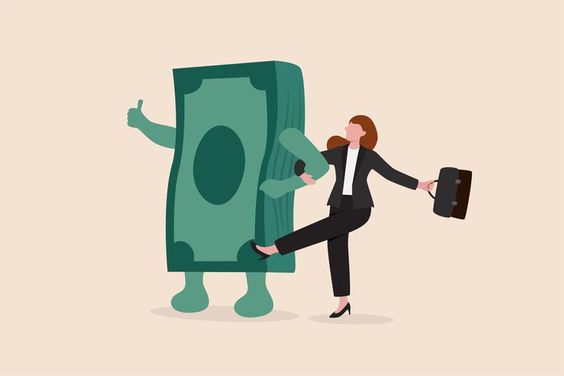
In any relationship, the first thing you need to know is if the feelings are mutual, the same is when it comes to your relationship with money. It would be a rhetorical question to ask if you love money, rather what you really need to ask yourself is does money love you?
And to answer this question, we need to analyze the quality of attachment, and the reason behind our affection for money. You all might think this is a no-brainer – because money gives us the power to lead a life we fancy right? Well, it is not that direct.
The feelings toward money at first glance seem to be positive, but it might not always be so.
Our perception of earning, spending, and donating is built through past experiences, circumstances we have lived in, the perception of money of our parents and friends, and our understanding of how money works.
It is important to ensure that your love for money does not stem from a place of need or desperation, because in that case, you would not be able to sustain the relationship for too long.
In other words, when you are desperate to have money, you are also quick to spend it all, by not making sound financial decisions. So how we perceive earning and spending money needs to be changed from the core to have a long-lasting and happy relationship.
To start with, address decisions relating to money – as a way to create wealth, because money in its most economic terms is only a means, but wealth is about having the right assets and capability to lead a life of your liking not just today but for years to come. So always look at earning and spending from a long-term lens.
Though there are many aspects when it comes to building a healthy relationship with money. In this article, I am going to talk about one of the non-financial habits that have helped me improve money’s love towards me.
I call this habit- Justice Price Tag.
You all must have noticed how in your households the expensive crockery, bedsheets, or curtain is saved for later. It is only used when some guests come around, or sometimes it is never used. Now, this habit trickles down to the next generation as well. I noticed that even I would treat the expensive things that I buy be it food, clothing, or home decor differently than other everyday things. At first glance there is nothing problematic with it, but when you ask “why” repeatedly, it takes you to the root.
But before that, you need to ask yourself do you treat/use relatively less costly things recklessly? If the answer is yes (be honest), then that needs to be changed too. Coming back to the analogy, respect is as important as love in any relationship.
So be it expensive or not, things that you are able to buy through money should be treated with care. Not only is this financially sound advice but it also helps you value things on the utility it provides and how much easier it makes your life rather than on price tags (which anyway is not the right attitude to have).
So, now when I asked the question “why” repeatedly to myself, I arrived at the bottom of the problem/urge to hoard expensive things instead of using them.
- The belief that using something expensive daily would diminish its value
- The belief that using something expensive daily means I would be living a lifestyle I have never lived or not allowed to
- The belief that using something expensive today means I would not have it tomorrow
What is wrong with these beliefs? It stems from an emotion of self-doubt of not deserving a certain kind of lifestyle or not having confidence in oneself to be able to earn enough to have the same things tomorrow. This brings us back to the feeling of scarcity, translating it into need. This is exactly what we don’t want.
Rather we want to have an attitude of abundance towards money, to have a successful relationship with it.
Now if you notice all of these beliefs come from years of conditioning, and hence in order to change them completely, one needs to be conscious of their efforts and thoughts. So I devised a formula and it has worked wonders!
The Justice Price Tag Formula
Every time you are buying something, think about what it is going to provide to you in terms of:-
- Use-value
- Emotional value
- Frequency of Use
Do this with all the things i.e. don’t discriminate on grounds of price. Not only does this prevent you from making wasteful expenditures, but also allows you to fully enjoy the things as well as make you more mindful of your thoughts about spending and earning. Further, this instills respect for things you use and makes you value them more, hence creating positive energy around spending.
When I am buying food items, I think about how it is going to nourish me, and how it is going to uplift my mood. When it comes to clothes I think about how often am I going to be able to use them and how a piece of cloth makes me feel about my body and how it feels on my body, and so on and so forth. It is crucial that you are honest with yourself when you are asking yourself these questions. Do this for a month consciously, and there will come a point you would be asking and answering these questions on auto-pilot mode.
Once you have bought something, remind yourself about the conversation you had with yourself when you were buying, and in no time you would see you would be doing justice to price tags i.e you would be buying and using things because of their utility and happiness value, and nothing else, in turn making your relationship with money stronger.
 Sugar Words
Leave a comment